Organizations rely on structure to get work done. We use daily huddles to stay aligned, established project routines to keep improvements moving, and shared expectations to avoid reinventing the wheel every week. It is just part of running a good operation.
Why should we treat our approach to leadership any differently?
Leaders shape how work happens for everyone around them. What they choose to focus on, the questions they ask, and how consistently they show up sends a signal to the entire organization. When those behaviors change from day to day, teams feel it. When they become intentional and repeatable, people know what matters.
Leader Standard Work is meant to bring that consistency to leadership. It's used to create a set of routines and practices that keep leaders connected to the work, developing their teams, and reinforcing a culture where continuous improvement can actually stick.
What Is Leader Standard Work?
Leader Standard Work (LSW) is a lean management document that defines a leader’s workflow by structuring their daily, weekly, or monthly routines. The goal of using leader standard work is to develop leadership behaviors that drive performance, improvements, and engagement. Ultimately, those behaviors shift a leader from habitual firefighting to intentional routines that link daily actions to strategic goals.
Its purpose is to create a standard work for leaders that connects to their daily management system, shifting behaviors and routines from a reactive mindset to a proactive one. Leader Standard Work is different from process or operator standard work. Instead of prescribing exact steps, it creates a structured set of routines that align with a leader’s specific responsibilities, priorities, and workflow.
As a document aimed to support the individual leader, it targets specific challenges currently holding the person back, such as an 80-hour work week, an overflowing email inbox, or a lack of face time with teammates. It is not a checklist or prescribed steps, but it is used to create consistency in routines.
The result of effective LSW is efficient management, which, in turn, helps entire organizations run smoothly.
Why Is There a Need for Leader Standard Work?
Leader standard work documents create accountability and help leaders work on the business rather than only reacting to daily issues. This is essential for sustaining continuous improvement and a Kaizen mindset. As leaders move away from direct process work, their role shifts toward creating and maintaining the organization’s operating rhythm.
Most leaders have clarity about objectives and what needs to be done, but are less assured about the “how”. A documented schedule that outlines routines with clarity addresses the gap between strategy and day-to-day execution, resulting in actions that facilitate better leadership and ultimately drive teams toward better outcomes. It is a particularly powerful tool for addressing commonly shared goals, such as achieving 'Inbox Zero' or blocking unscheduled time for reflection.
Alignment between strategy and daily routines reduces reactive firefighting and allows leaders to act with intention. It prevents leaders and teams from being consumed by daily crises and ensures their actions add value.
Without defined, documented leader standard work schedules, inconsistent leadership behaviors emerge, leading to inconsistent results and temporary fixes that fail to deliver sustained success. Eradicating this through strategic alignment and a stable environment fosters a culture of continuous improvement and predictable growth.
What Leader Standard Work Looks Like in Practice
Leader Standard Work protocols may see leaders incorporate a variety of daily, weekly, and monthly tasks into their schedules to promote operational efficiency and continuous growth.
Daily Leadership Routines
- Daily huddles: Brief (up to 15-minute) meetings held at the same time each day can be utilized to outline daily goals or priorities, review the previous day’s output, identify potential roadblocks, and deliver clear guidance.
- Reviewing KPIs: Key Performance Indicator reviews are necessary to ensure teams and organizations are working toward outcomes consistent with the company’s mission statement and overall objectives.
- Removing barriers: Identifying and addressing barriers, implementing safe-to-try policies, and addressing inefficiencies creates an environment of psychological safety. It creates a shift from gatekeeping to groundskeeping.
Weekly / Monthly Leadership Routines
- Gemba walks: Visiting the physical workplace to observe and analyze processes. The goal is to gain a deeper understanding and identify strategies to improve operations. It does not set out to critique individual workers.
- Tiered accountability meetings: Tier 4 leadership meetings focus on reviewing KPIs, strategic goals, and financial metrics. Through quick interventions and rapid problem-solving, they promote a proactive culture of continuous improvement.
- Coaching problem-solving: The goal of this routine is to help individuals gain the confidence, independence, and ownership to make decisions and solve problems without needing permission from senior staff.
- Following up on countermeasures: Regular reviews of countermeasure actions set out to confirm suitability and effectiveness while also proactively preventing recurrence. If actions fail, steps can be taken to address root causes.
Description of Leader Standard Work at Varying Management Levels
One of the biggest misconceptions about Leader Standard Work is that it looks the same for everyone. It does not. The purpose stays consistent, but the focus changes depending on where a leader sits in the organization. The higher you go, the less it is about managing tasks and the more it is about creating direction and visibility.
Frontline Leader
For frontline supervisors and team leads, Leader Standard Work tends to be the most structured and time-bound. Their role is close to the process, so their routines often include daily huddles, checking visual boards, confirming standard work is being followed, and removing small barriers that slow teams down.
A large portion of a frontline leader’s day may be guided by Leader Standard Work because consistency at this level stabilizes the operation. You will often see these leaders focused on leading indicators such as safety checks, flow of work, staffing alignment, and immediate problem escalation. Visual management plays a big role here because it allows issues to surface quickly without long meetings or complicated reporting.
Mid-Level Manager
Mid-level managers sit between strategy and execution, which means their Leader Standard Work shifts toward alignment and coaching multiple teams to perform together.
Their routines might include reviewing performance trends, mentoring frontline leaders, and connecting improvement efforts to broader business goals. Leader Standard Work at this level is about creating rhythm, such as performing weekly KPI reviews, cross-functional meetings, and follow-ups on improvement work.
This is also where the balance between leading and lagging indicators becomes important. Mid-level leaders need to see what is happening now while also understanding what the results are telling them over time. Dashboards and visual summaries help them quickly assess where support is needed without getting lost in the details.
Senior Leader
Senior leaders approach Leader Standard Work very differently because their focus moves beyond the process itself. They are thinking about market position, growth, risk, and long-term direction. Their routines are not about managing hourly activity. They are about ensuring the organization is pointed in the right direction and that improvement efforts support strategic priorities.
Leader Standard Work for senior leaders might include structured time for strategy reviews, market analysis, leadership coaching, and alignment conversations across departments. The cadence becomes less frequent. Instead of reviewing daily metrics, executives may focus on monthly or quarterly performance patterns, planned time for innovation or reflection, shifts in market share, and whether the organization is building future capability.
Even at this level, visibility still matters. It helps leaders stay connected without getting pulled into operational noise.
What Should Be Included in Leader Standard Work?
Before rolling out your Leader Standard Work, focus on creating a document that guides daily leadership behavior. A template or checklist can help you get started, but each leader’s standard work should reflect their specific responsibilities and the needs of their team.
- Start with strategy and priorities.
Decide what outcomes you are responsible for, such as safety, quality, delivery, cost, or team development. Your standard work should focus on the activities that directly influence those results.
- Identify critical routines.
List the leadership activities you must perform regularly, such as daily huddles, gemba walks, reviewing visual boards, removing obstacles, and coaching employees. Assign each a frequency (daily, weekly, or monthly).
- Define a cadence.
Schedule when these activities will occur. For example, hold daily huddles at shift start, perform gemba walks mid-morning, and conduct coaching sessions weekly. The goal is to make leadership work intentional instead of reactive.
- Pilot, adjust, and improve.
Start with two or three routines and follow them consistently. After a few weeks, review what worked and update the document. Leader Standard Work should evolve as your processes and team improve. Decide what outcomes you are responsible for, such as safety, quality, delivery, cost, or team development. Your standard work should focus on the activities that directly influence those results.
How Often Should Leader Standard Work Be Reviewed?
That's a trick question. You should be looking at your leader standard work every day. It’s your personal leadership map that keeps your leadership moving in the right direction. Cultivating an environment built around continuous improvement thrives on daily accountability. Furthermore, this allows you to identify issues and improve through iteration. This will morph naturally over time as the behaviors you want to develop become second nature.
Leader Standard Work Is Not an SOP and That Matters
Creating the conditions for a continuous improvement culture requires a focused and consistent method of aligned feedback and reinforcement. It evolves alongside the business, which is why the only wrong Leader Standard Work is if you don’t have any. Nevertheless, if your organization doesn’t have a true north, the impact of your LSW will be limited. The energy it takes to keep consistent to your LSW will become too high and often results in going back to the status quo.
The harsh reality is any time spent on urgent but not important issues and tasks is time lost, resulting in days filled with busy work that fail to deliver the results needed. Sustaining leader standard work with a living document takes your normal bias and makes sure you are focused on getting important things done. Daily, weekly, and monthly.
To prevent your LSW from becoming a static document with limited rewards, be sure to include the following.
- Regular review and refinement: Whether your LSW is failing to align the “what” with the “how” or situations are changing, iterating and scaling leader standard work documents is pivotal for continuous improvement.
- Coaching and feedback loops: While LSW is about you, leadership largely hinges on getting the best out of a team. When the leader's standard work leaves room for actively helping employees while giving them a voice, it facilitates collective growth.
- Tied to management operating system: As the glue of lean culture, LSW must integrate with the management operating system (MOS) to ensure that operations are ordered, organized, and measurable.
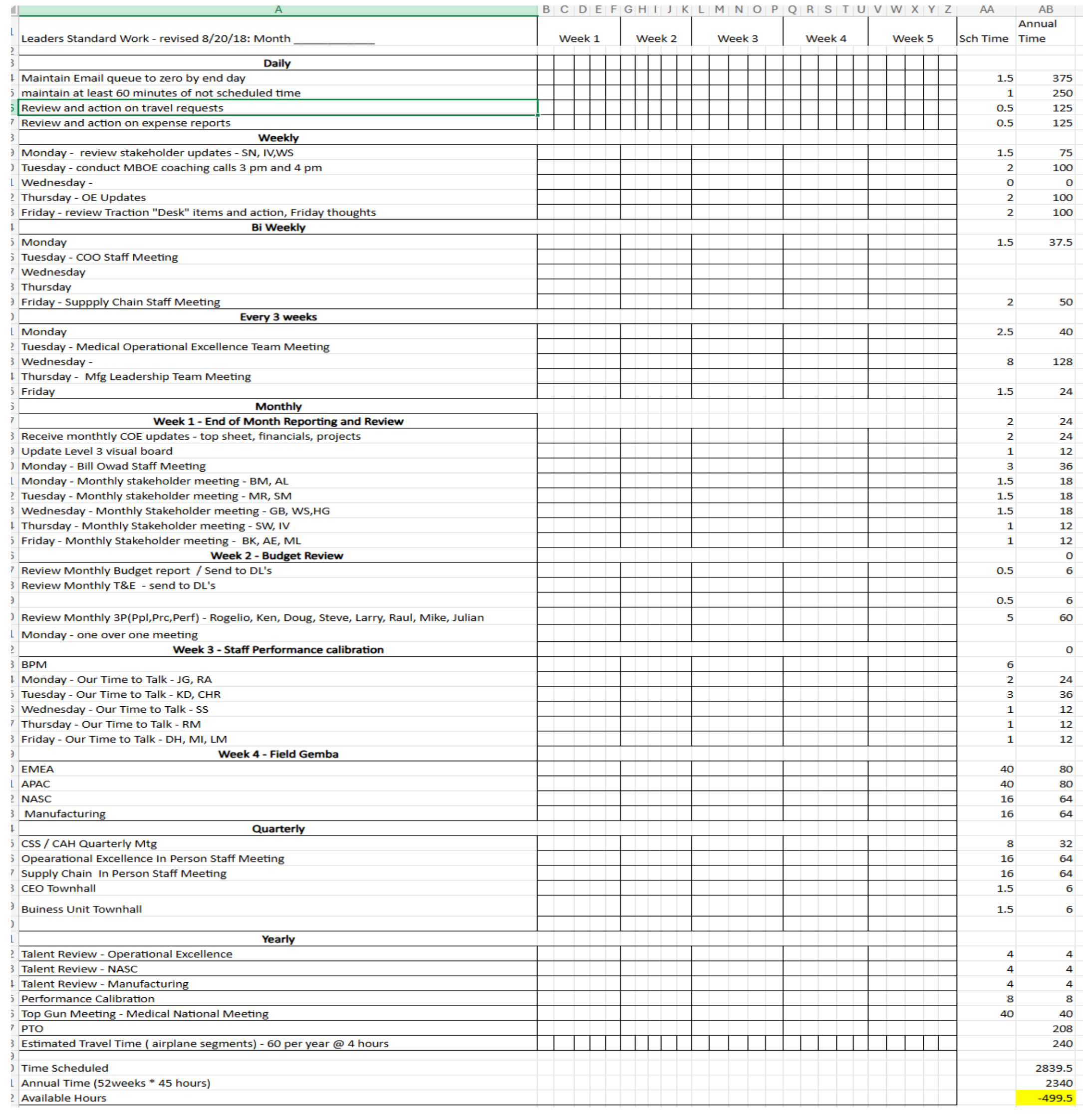
The example shown here illustrates how Leader Standard Work can be structured for a Vice President–level Continuous Improvement leader overseeing nine direct reports and a global team of more than 200 associates. The routines are organized across daily, weekly, monthly, quarterly, and annual rhythms, highlighting how leadership time and attention are intentionally scheduled to support both operational priorities and long-term development.
Common Mistakes with Leader Standard Work
The biggest trap leaders fall into with LSW is thinking it’s standard operating procedure that everyone will follow. It is not a controlling document for teams. It is a self-accountability document designed to help you become a better leader through effective routines and leadership processes.
Common mistakes leader standard work must avoid include;:
- Turning it into a compliance checklist
- Copying templates without context
- Not actively tracking compliance
- Treating LSW as static
- Not coaching leaders on how to use it
- Treating it as a standard operating procedure (SOP)
Meanwhile, LSW should stay connected to your Operating Plan. Otherwise, you fall back into old firefighting routines rather than proactively solving problems. The best results are seen when the organization already has its operating system, true north, tiered management process, cascading goals, and assessments clearly defined.
Leader Standard Work Builds Culture One Routine at a Time
Building a culture of continuous improvement relies heavily on leadership routines that establish consistent behaviors. If we believe structure helps operators perform consistently, helps teams move work forward, and helps processes improve over time, then leadership deserves the same level of intentional design. Leadership is still work, and like any other critical process, it benefits from clear expectations, visible routines, and a shared rhythm.
Improve yourself through a leader standard work document that aligns strategy with daily tasks and to become a consistently high-performing leader and encourage company-wide continuous improvement.