Methodology Overview
New to Lean Six Sigma?
If you're new to Lean Six Sigma, MoreSteam has many free resources to help you get started. This page covers the following topics:
- What is Six Sigma?
- The Five Phases of Six Sigma
- Then what is Lean?
- So, how did it become Lean Six Sigma?
- What are "Belts"?
- And what is Design for Six Sigma?
- Statistics, Tools, and Techniques
- How can you learn more?
What is Six Sigma?
Six Sigma is a comprehensive and flexible system for achieving, sustaining, and maximizing business success.
What Makes Six Sigma Different?
Six Sigma is uniquely driven by a close understanding of customer needs, disciplined use of facts, data, and statistical analysis, and diligent attention to managing, improving, and reinventing business processes (from the book The Six Sigma Way by Pande, Neuman, and Cavanagh).
The Six Sigma methodology is based on the concept that "process variation" (e.g., customer waiting times at a call center varying between ten seconds and three minutes) can be reduced using statistical tools.
The ideal goal is to fix a process to be 99.9997% defect-free or produce only 3.4 Defects per million opportunities or less! For example, this could mean 3-4 broken light bulbs in one million produced or 3-4 customer calls with waiting times more than one minute. From a statistical standpoint, this means that a process centered at the target has six Standard Deviations (sigma) between the process mean (the target) and the nearest specification limit.
The Five Phases of Six Sigma
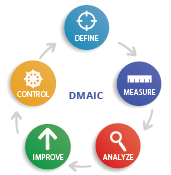
Six Sigma projects typically follow the five phases of the DMAIC framework: Define, Measure, Analyze, Improve, and Control.
These phases each contain tools and techniques that guide the problem solver through the improvement process from start to finish.
Learn more about the DMAIC method here.
Then what is Lean?
"Lean" (also called Lean Methods or Lean Speed) is a set of tools developed to reduce the waste associated with the flow of materials and information in a process from beginning to end. The goal of Lean is to identify and eliminate non-essential and non-value-added steps in the business process to streamline production, improve quality, and gain customer loyalty.
Lean Methods can be employed within the DMAIC framework to augment Six Sigma tools when the project focuses on improving process speed and efficiency.
Learn about the Lean Roadmap - The Planning and Implementation Process.
So, how did it become Lean Six Sigma?
Using more problem-solving techniques can help solve a larger number and variety of business problems. Starting in the 1980s, consultants trained in both techniques realized the synergy between Lean and Six Sigma. They began to push for combining the different tools of Six Sigma (focused on improving quality) and Lean (focused on removing waste).
Thus, Lean Six Sigma (LSS) was born.
A combined management approach, Lean Six Sigma amplifies the strengths and minimizes the weaknesses of both methods.
Increasingly popular, Lean Six Sigma first emphasizes the use of Lean methodologies and tools to identify and remove waste and increase process velocity, then follows that with the use of Six Sigma methodologies and tools to identify and reduce or remove process variation.
Most deployments (organizations that run quality initiatives within a company) now use Lean Six Sigma rather than one or the other methodology.
What are "Belts"?
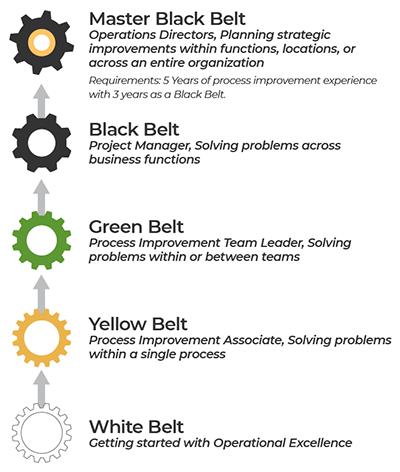
A "Belt" signifies experience. Practitioners earn a "Belt" title (Black Belt, Green Belt, Yellow Belt) that corresponds to their level of expertise.
This roughly corresponds to the hierarchy in martial arts, with darker-colored belts indicating more experience (more training, knowledge, and skills). For a visual example of the belt levels, visit our Belt comparison blog.
White Belt
A White Belt has received a small amount (several hours) of awareness training. Enough to be dangerous!
Most White Belts are executives or staff who just need to know the very basics of process improvement. White Belt training assists change management and cultural buy-in from professionals who won't use the tools but may be impacted by projects.
Champion
A project Champion is a high-ranking manager who works with a Black Belt to remove the barriers to project success and ensure the project team has the organizational support it needs to be effective.
Champions are not expected to be experts in the statistical tools or even experts in the project's specific subject matter. Instead, they must possess a breadth of organizational knowledge to ensure that the project team's work is aligned with the organization's strategic objectives and interfaces effectively across the organization. A champion must also have the organizational clout to 'make things happen.'
Yellow Belt
A Yellow Belt knows the general Lean Six Sigma concepts and essential tools.

Yellow Belts can expect to participate on a project, typically led by a Green Belt, as a team member. They might also participate in quick-hit kaizen events that require deep focus for several days in order to solve an immediate problem. Yellow's are responsible for solving smaller process problems around them that do not require the use of advanced statistics.
The Yellow Belt body of knowledge is defined quite differently by different organizations. In some cases, it may represent only the most basic concepts and language of Six Sigma, with an overview of the DMAIC process. In other instances, Yellow Belts are trained in a more complete set of essential tools, typically representing 15 to 25 hours of training.
Green Belt
A Green Belt has substantial knowledge and skills related to the DMAIC methodology and Lean methods but typically does not have experience with advanced statistical tools such as design of experiments (DOE).
Green Belts may lead simple projects under the guidance of a Black Belt or may work as a team member on a large project team. Green Belt training can be obtained from a variety of sources, but is typically less than 100 hours in duration and includes instruction in the basic use of statistical data analysis, with emphasis on team problem-solving techniques.
Green Belt Certification - the recognition of both knowledge and the practical application of skills - is offered by MoreSteam, other organizations, and consulting firms.
Black Belt
A Black Belt has expert knowledge and skills related to the DMAIC methodology, Lean methods, and team leadership.

Black Belt training can be obtained from a variety of sources but is typically between 140 and 160 hours in duration and includes instruction in the use of statistical data analysis, designed experiments, team leadership, and project management.
Black Belt Certification - the recognition of both knowledge and the practical application of skills - is offered by MoreSteam, other organizations, and consulting firms.
Master Black Belt
Master Black Belts are seasoned Black Belts who have extensive advanced training in design, stats, and modeling. Master Black Belts will often lead entire process improvement initiatives and help coach Black Belts and Green Belts through their projects.
Master Black Belts are responsible for identifying more extensive improvement opportunities that may break into a collection of projects across the value stream. They act as a bridge between management levels within the organization, consistently communicating the value of Lean and Six Sigma problem-solving.
Master Black Belt Certification - the recognition of knowledge, leadership, and practical application of skills - is offered by MoreSteam, other organizations, and consulting firms.
Learn more about what it takes to become a Master Black Belt here.
And what is Design for Six Sigma (DFSS)?
Lean Six Sigma tries to fix broken processes that already exist. But what if there were a way to create higher-quality processes at the design stage?
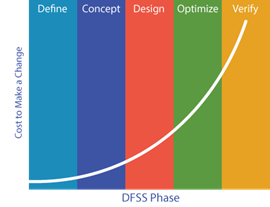
A variant of Six Sigma, Design For Six Sigma (DFSS), is a methodology used to design from scratch or re-design a product or process to one that meets customer requirements and has an expected quality level of Six Sigma.
DFSS is about "getting it right the first time" instead of improving later (the focus of DMAIC Six Sigma). That's where the cost of change is lowest, and the ease of implementation is the highest. Then, all of Lean's tools and techniques are added to the mix. A growing number of deployments are describing their efforts as DFLSS.
Statistics, Tools, and Techniques
The LSS methodology relies on an impressive number of tools and techniques (e.g., Fishbone Diagrams, Statistical Process Control Charts, 5S), many of which have been collected from earlier quality methodologies.
This makes LSS familiar to many quality practitioners and thus, easy to learn. The DMAIC framework organizes the tools into the appropriate order for project work.
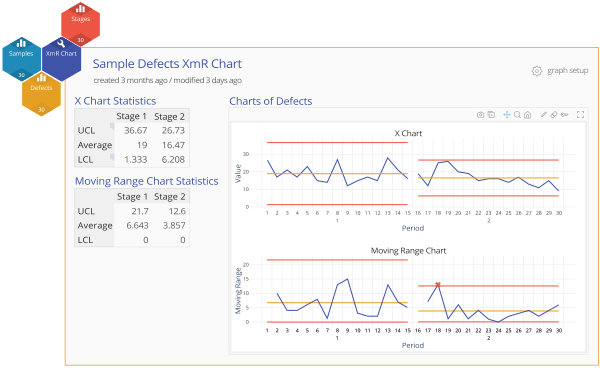
LSS also relies on statistical tools and tests to better understand the trends in process metrics and data. In training, Six Sigma practitioners learn to calculate many of these statistics by hand or with a calculator. But in actual project work, they rely on tools such as EngineRoom® to help automate and simplify the statistics and provide statisticians and non-statisticians with data analysis tools and templates.
The MoreSteam Lean Six Sigma Toolbox is a free series of short tutorials that covers a wide range of tools employed in a typical Lean Six Sigma project, including Flow Charts, Histograms, Root Cause Analysis, Design of Experiments, and many more. Some tutorials also include downloadable Excel templates. MoreSteam's eLearning classes include more extensive versions of these tutorials.
Important Note: Organizations may also refer to their improvement systems as Process Improvement, Continuous Improvement, Process Excellence, or Operational Excellence. The tools and techniques are generally the same.